

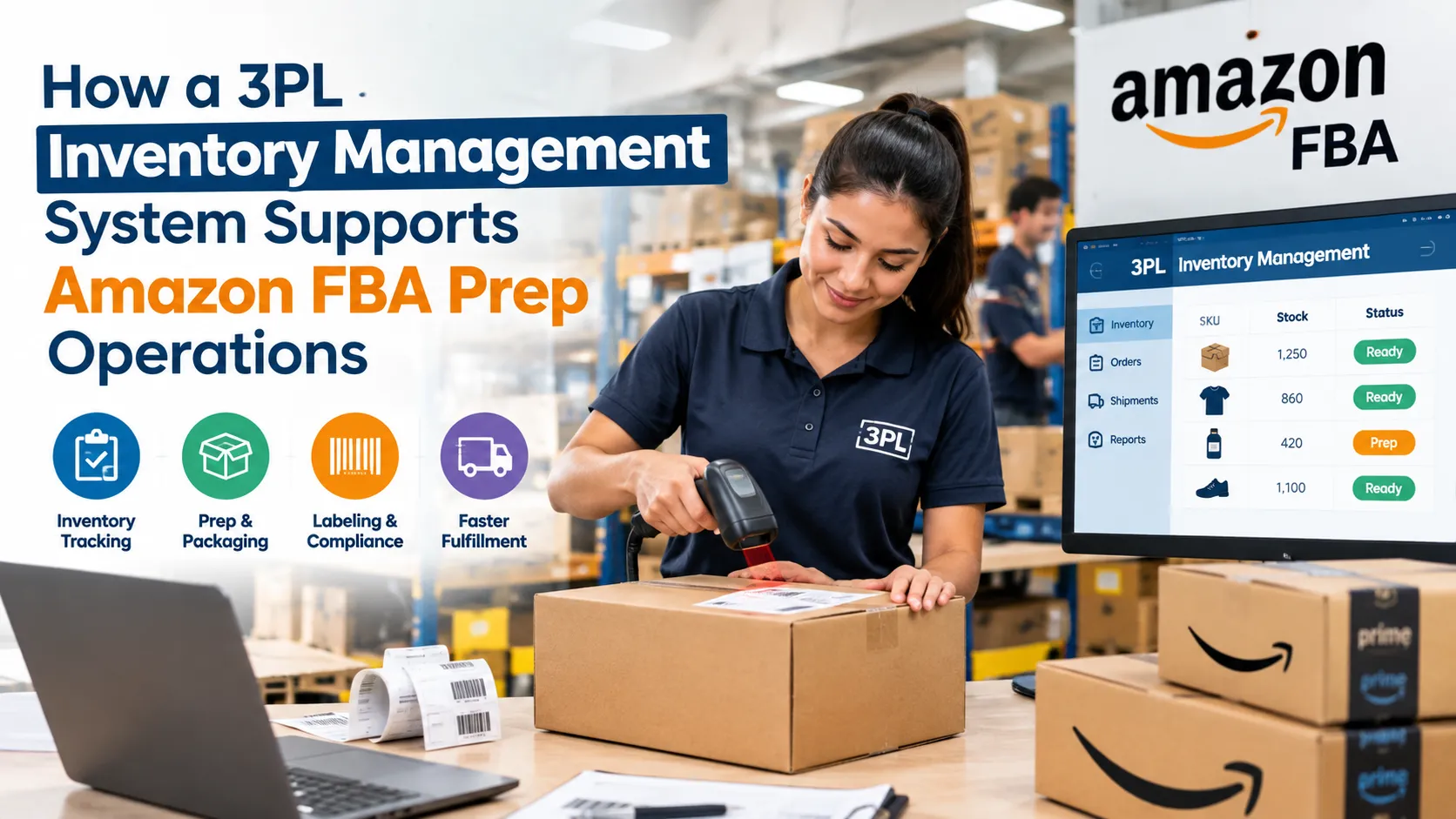
Most Amazon sellers treat FBA prep compliance as a solved problem. They onboard a 3PL, confirm the prep checklist, and move on. What they don’t account for is what happens when Amazon changes its requirements mid-cycle — and their 3PL’s system isn’t built to respond in time.
Units move. Labels get applied. Shipments go out. The compliance update Amazon published days ago never reached the warehouse floor. By the time the FC rejection lands, a reliable 3PL inventory management system has already proven its worth — or its absence.
Amazon’s FBA Prep Requirements Are Not Static
Amazon’s prep standards have shifted repeatedly — poly-bag thickness thresholds, suffocation warning label sizing, FNSKU placement rules, carton weight limits. These are documented requirement updates that have caught active sellers mid-shipment with no warning.
The misconception is consistent: sellers and their 3PL partners treat FBA prep requirements as a fixed reference point. They configure the workflow once, train the team, and consider the matter closed. That assumption holds until Amazon changes something.
When a requirement changes mid-shipment cycle, Amazon does not absorb the cost. The 3PL rarely does either. The seller does — through rejections, re-prep fees, and delayed restocks. In-house prep teams receive the change and update their process directly. Sellers using a 3PL depend entirely on their 3PL’s system to surface that change and enforce it before the next shipment leaves the dock.
Where Compliance Lag Actually Happens
Compliance lag is the gap between when Amazon publishes a prep requirement change and when that change is enforced on the warehouse floor. It is a system architecture failure, not a policy failure.
The typical 3PL operation runs on two separate workflows: inventory data lives inside the WMS, and prep instructions live somewhere else — a spreadsheet, an SOP document, or a verbal handoff at shift change. These two systems rarely communicate in real time. That gap is where compliance lag lives.
Three failure points appear most consistently:
-
A batch of units is already mid-prep when Amazon’s updated requirement goes live. No system flag exists. Prep continues under the old spec.
-
The account manager updates the SOP. The floor team executes the previous version. No enforcement mechanism connects the two.
-
Labeling and bundling specs are tied to SKU records requiring manual updates — one product, one shipment, one person with access.
The financial consequences are direct. Amazon FCs reject non-compliant shipments. Unplanned prep fees — charged when FC staff correct non-compliant units on arrival — are non-negotiable and non-refundable. Restock timelines slip by days or weeks. During peak periods, that delay costs more than the prep error itself.
Why Generic WMS Platforms Fall Short
A Warehouse Management System tracks inventory movement — units in, units out, bin locations assigned. FBA prep compliance requires something different: dynamic, SKU-specific prep instruction enforcement that reflects current Amazon standards.
The configuration burden itself is the risk. Every time Amazon updates a requirement, someone must locate the affected SKU records, update the prep instructions, confirm the update reached the floor, and verify it applies to in-progress shipments. That chain has four failure points before a single unit is correctly prepped.
Generic platforms patch this gap with documentation. Documentation is not enforcement. 3PL inventory management software built for general warehousing was never designed to handle the specificity Amazon FBA demands.
What a Purpose-Built FBA Prep System Does Differently
The structural difference is singular: a purpose-built 3PL inventory management system collapses the inventory layer and the prep instruction layer into one unified workflow — one system with a single source of truth.
Three capabilities make this operationally meaningful:
-
SKU-level prep rule enforcement. Prep instructions attach directly to the SKU record. When a prep rule changes, the update propagates instantly across every active shipment containing that SKU — no manual intervention, no document version lag.
-
Shipment-stage tracking. The system tracks where each unit is within the prep cycle — received, inspected, labeled, bundled, staged for pickup. “In stock” is not a status. Stage position is.
-
Compliance checkpoints. Built-in confirmation steps require floor staff to verify prep against current specs before a unit advances to the next stage. The checkpoint is the enforcement mechanism, not a downstream audit.
When Amazon updates poly-bag requirements, the change surfaces immediately as a flag on every affected SKU in every active shipment. It does not generate a memo. It generates a system-level hold that floor staff cannot bypass without acknowledgment.
The Stakes During Peak Periods
Compliance lag is a recurring cost in normal conditions. During Q4, Prime Day, or any high-velocity promotional window, it becomes a business-level risk.
A non-compliant shipment triggers this chain: FC rejection → shipment returned to 3PL → re-prep under corrected specs → re-shipment delay → listing goes out of stock. The listing impact extends beyond the stockout window. Amazon’s algorithm suppresses rankings for ASINs that go out of stock during high-traffic periods. Sellers lose the Buy Box. Organic ranking recovers slowly.
The root cause frequently goes undiagnosed. Sellers attribute a Q4 ranking drop to ad spend or competitor activity. The actual origin — a 3PL compliance failure on a mid-October shipment — never surfaces in a post-mortem.
Amazon’s unplanned prep fees add a second financial layer. When an FC receives non-compliant units and preps them on-site, the fee is mandatory, immediate, and non-refundable.
Three Questions to Ask Your 3PL Now
Before the next peak window, every seller should ask their 3PL directly:
-
Where do your prep instructions live — in your WMS, or in a separate document? If the answer is a spreadsheet or SOP file, the instructions are decoupled from inventory. That gap is the compliance lag risk.
-
How does a change to Amazon’s prep requirements get enforced on the warehouse floor, and how fast? A credible answer names a specific system mechanism. A non-credible answer describes a communication process.
-
Can you show me a shipment-stage report for my last five ASINs? If the 3PL tracks units only as “in stock” or “shipped,” they have no stage-level visibility. Neither do you.
A 3PL that cannot answer all three clearly is carrying a compliance lag risk — and passing it directly to the seller.
How PrepShipHub Closes the Compliance Gap
PrepShipHub’s architecture treats inventory management and prep instruction management as a single operational layer. Prep rules attach at the SKU level — not in a separate document requiring manual cross-referencing. When a requirement changes, the update applies system-wide across every active shipment for that SKU automatically.
Sellers have shipment-stage visibility as a standard feature. The question shifts from “where is my inventory?” to “where is each unit within its prep cycle?” Most 3PL inventory management software answers only the first one. PrepShipHub answers both.
Compliance checkpoints enforce verification before any unit advances through the prep workflow. For sellers whose revenue depends on FBA availability during high-velocity windows, the 3PL inventory management system powering their 3PL is a direct competitive variable — not a background operational detail.
FAQs
-
What is compliance lag in FBA prep?
The delay between when Amazon updates a prep requirement and when that update is enforced on the warehouse floor. It happens because most 3PLs store inventory in a WMS and prep instructions in a separate document. When a requirement changes, no automated link exists between the two systems.
-
Are Amazon’s FBA prep requirements the same for all product categories?
No. Amazon applies category-specific requirements across its catalog — apparel, fragile items, sets, and bundles each follow distinct rules that change independently. A prep system relying on manual updates to apply category-specific rules creates compliance risk on every non-standard ASIN.
-
What should sellers look for in a 3PL to avoid peak-period stockouts?
Three things: prep instructions stored inside the inventory system (not a separate document), shipment-stage tracking beyond basic stock counts, and built-in compliance checkpoints before units advance through the prep workflow.
